
The Pointer to Implementation (PIMPL) idiom is a technique used in C++ to separate the implementation details of a class from its public interface.
It is used to reduce the compilation dependencies of a class, improve encapsulation, and hide implementation details from the users of the class.
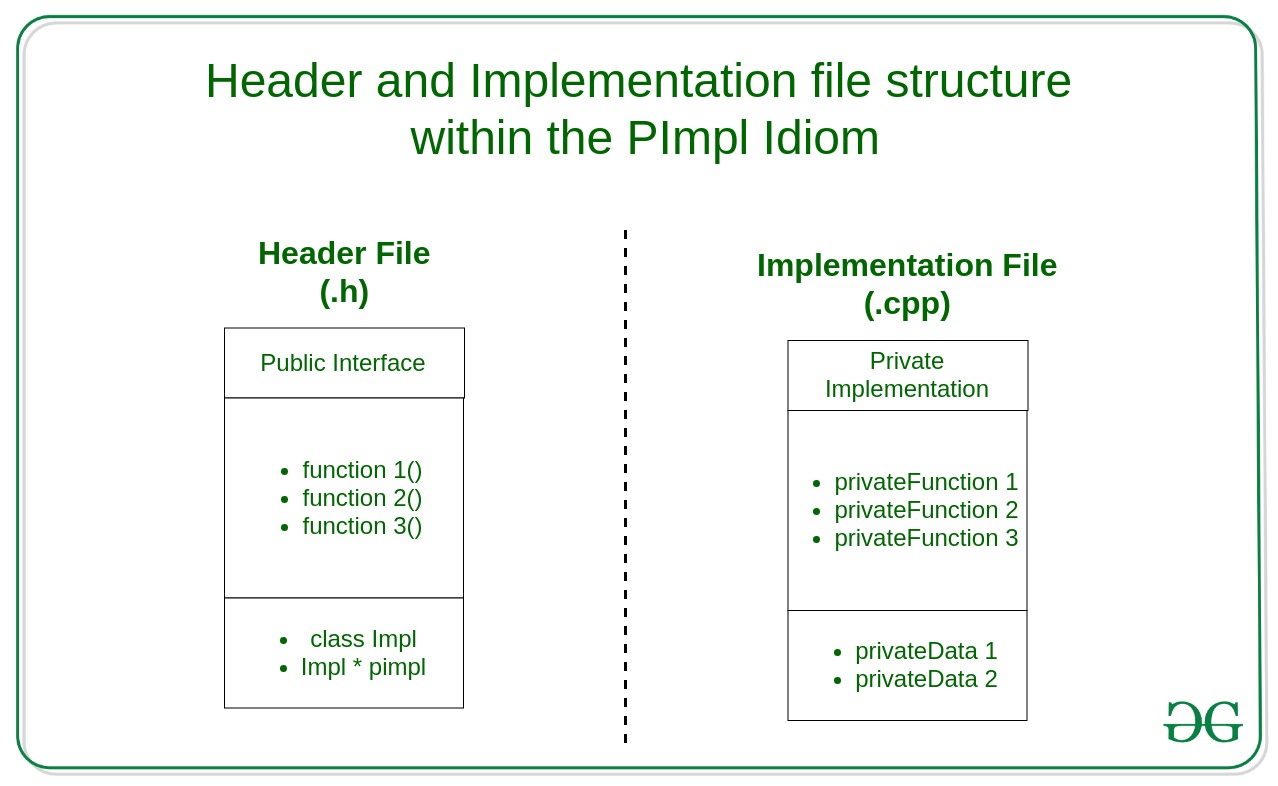
The PIMPL idiom is implemented by creating a private member of the class that is a pointer to an opaque implementation class. The implementation class is defined in the implementation file, and the public class has a public interface that uses the implementation class through the private pointer.
Here's an example of how you might use the PIMPL idiom to implement a simple class:
In this example, the MyClass class has a private member impl that is a pointer to an implementation class called MyClassImpl. The implementation details of MyClass are hidden from the users of the class, reducing compilation dependencies and improving encapsulation.
It's worth noting that C++11 introduced the std::unique_ptr which can be used to manage the memory of the implementation class and avoid the need to explicitly call the destructor of the implementation class.
The PIMPL idiom is implemented by creating a private member of the class that is a pointer to an opaque implementation class. The implementation class is defined in the implementation file, and the public class has a public interface that uses the implementation class through the private pointer.
Here's an example of how you might use the PIMPL idiom to implement a simple class:
// MyClass.h
class MyClass
{
public:
MyClass();
~MyClass();
void doSomething();
private:
class MyClassImpl;
MyClassImpl* impl;
};
// MyClass.cpp
class MyClass::MyClassImpl
{
// implementation details go here
};
MyClass::MyClass() : impl(new MyClassImpl) {}
MyClass::~MyClass() { delete impl; }
void MyClass::doSomething() { /* use impl to do something */ }
In this example, the MyClass class has a private member impl that is a pointer to an implementation class called MyClassImpl. The implementation details of MyClass are hidden from the users of the class, reducing compilation dependencies and improving encapsulation.
It's worth noting that C++11 introduced the std::unique_ptr which can be used to manage the memory of the implementation class and avoid the need to explicitly call the destructor of the implementation class.


No comments:
Post a Comment